

This fine example with open barrel back and dome top with three shaped shelves above double doors with fixed shelf below. With finely carved cornice, frame and frieze, the panelled doors with egg and dart frames. Previously fitted as indicated by the light switch on the right hand side.
Height: 81 inch (206 cm)
Width: 42 inch (107 cm)
Depth: 30 inch (76 cm)
£2,650
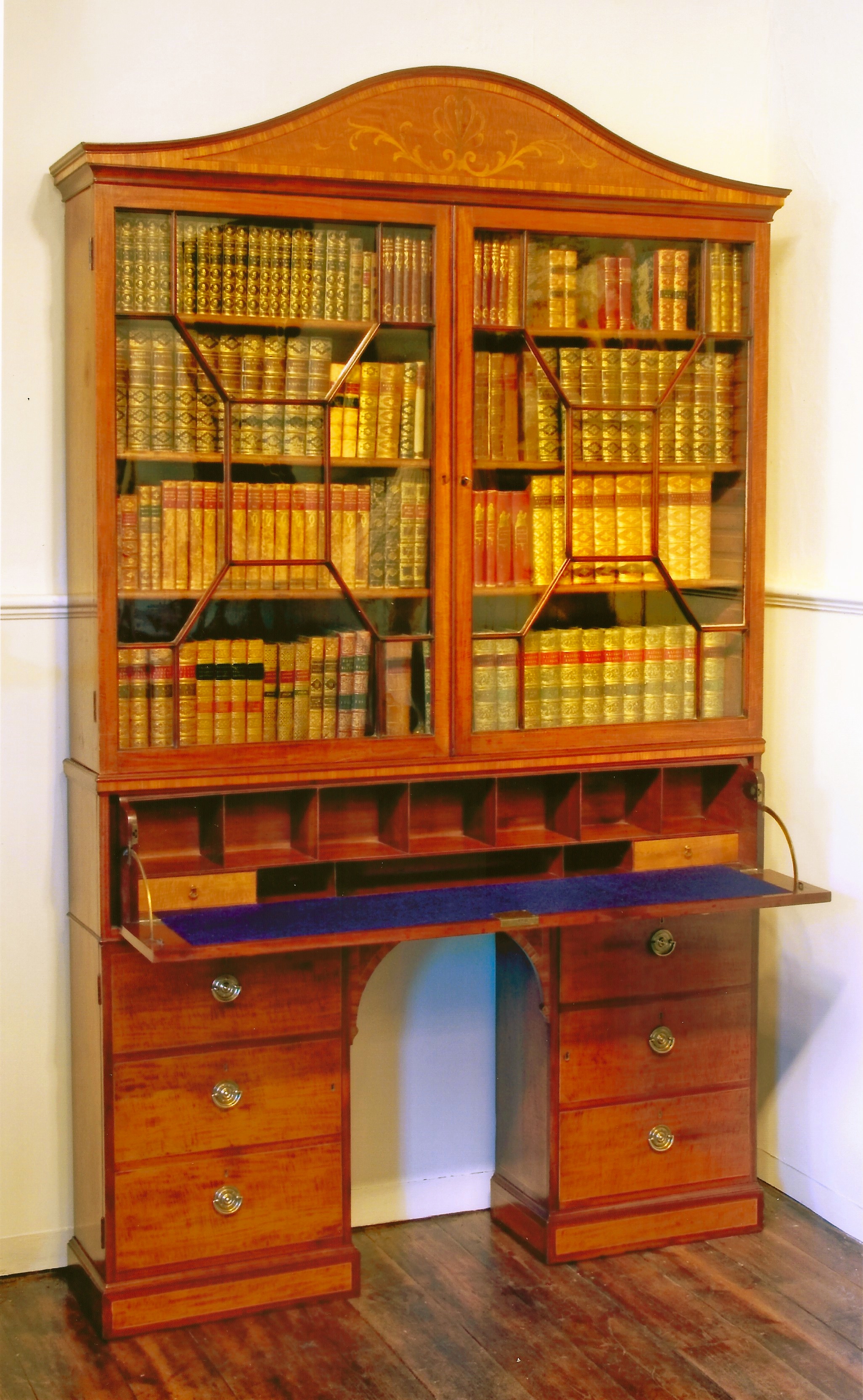
The arched top pediment to the glazed door upper section with adjustable shelves, the lower section with a shallow secretaire drawer with two drawers and pigeon holes; below are two cupboards, the doors disguised as drawer fronts, flanking the central arched kneehole. The whole standing on a plinth base.
This is an extremely rare example of English cabinet making during the Adam period. It is unique in its shallow proportions, being made specifically to order. . The cabinet bears all the hallmarks in its quality and Architectural design that may be attributed to a number of eminent makers including Messrs. Ince & Mayhew who, so it is recorded, worked consistently at Burghley during the latter half of the 18th century. Provenance: Originally acquired by John Bly in 1967 from a collector at one time in the household of Burghley House in Lincolnshire, the ancestral home of the Marquess of Exeter. It subsequently formed an important part of a private collection until its recent dispersement, once again to John Bly by private treaty.
Circa 1785
Height: 92 inch (234 cm)
Width: 55 inch (140 cm)
Depth: 11 inch (28 cm)
POA
Cabinets and cupboards are the backbone of refined storage, balancing display and discretion. This category includes larger statement cabinets as well as standing and hanging corner cupboards and other versatile forms that can hold ceramics, books, glassware, and household essentials. Expect pieces that work as anchors in dining rooms, hallways, and libraries, with solid or ‘blind’ doors, or glazed with fine astragal framing, containing shelves, and compartments designed to be used, not just admired.
Attributed to John Linnell and from Castle Howard where a collection of his furniture can still be found. It was sold as part of a Sotheby's contents sale on the premises and bears the house inventory number – 862.
The upper part with a moulded over-hanging fluted cornice above a stiff lotus leaf carved and swagged drapery marquetry frieze and a pair of panel doors enclosing twenty four pigeon holes each inlaid with a number or letter, the lower pair with a concave drawer and a rectangular moulded edge top above a frieze drawer decorated with running guilloche and rosette decoration and a pair of doors centred by a large circular roundel, enclosing four slides lined with marbled paper, on a plinth base, the reverse with an inventory label for JAS. BOWMAN & SONS, MONK BAR, YORK and printed '10'.
Circa 1785
Height: 87 inch (221 cm)
Width: 40.5 inch (104 cm)
Depth: 30 inch (77 cm)
Working locks with keys.
Provenance:
Provenance: Castle Howard, Yorkshire.
Probably supplied to Frederick Howard, 5th Earl of Carlisle
(1748-1825) and thence by descent to:
George Howard, 6th Earl of Carlisle
(1773-1848) and thence by descent to:
William George Howard, 8th Earl of Carlisle (1808-1889) and thence by descent to:
George James Howard, 9th Earl of Carlisle (1843-1911) and thence by family descent until sold: Sotheby's contents sale, Castle Howard 11th-13th November 1991, lot 115 and 116.
This cabinet relates to a design by John Linnell in the collection of the V&A Museum and dated to around 1765 (E291 1929).
A related bookcase also in the collection of the V&A Museum is illusrated by H.Hayward and P.Kirkham,
William and John Linnell, London, 1980. fig.18.
Frederick, 5th Earl of Carlisle was patron of John Linnell between 1777-1789.
Register interest
< BACK TO BOOKCASES