

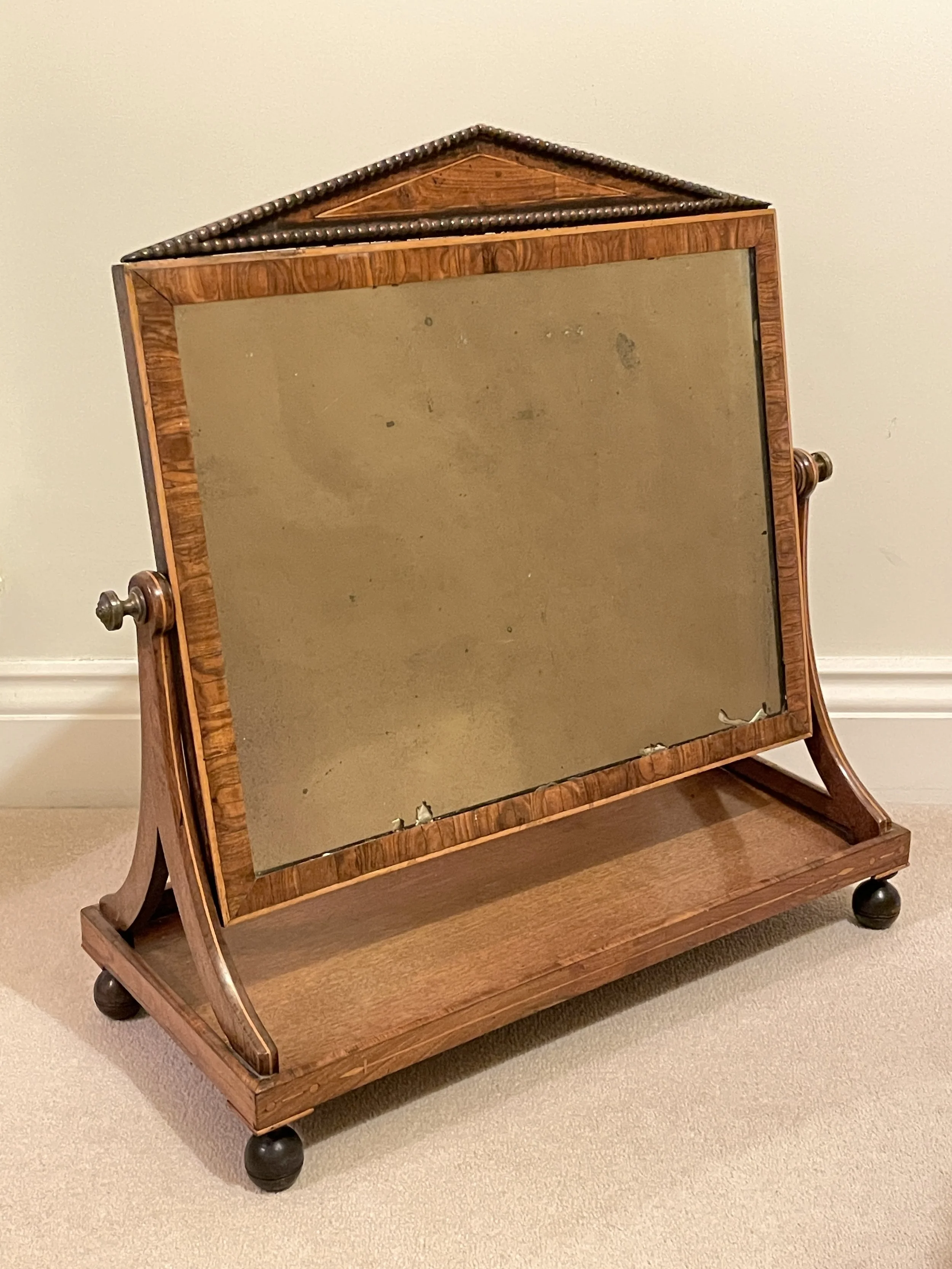
This charming early 19th century dressing or toilet mirror in mahogany with rosewood cross banded frame supported by two splay ends on a vide poche tray; with and boxwood inlay and stringing throughout on ebonised ball feet and retaining its original plate.
Circa 1820
Height: 23¼” (59 cm)
Width: 21¾” (55 cm)
Depth: 8” (20 cm)
£1,850

A superb and large mid 19th century mirror.
The fine moulded gilt slip surrounded by carved and painted frame with gilt plaster floral swags and festoons with bows centre and corners. Could be placed above an overmantle or on the floor.
Circa 1850
Height: 75" / 190.5 cm Width: 69" / 175.5 cm Depth: 4" / 10 cm
£12,500
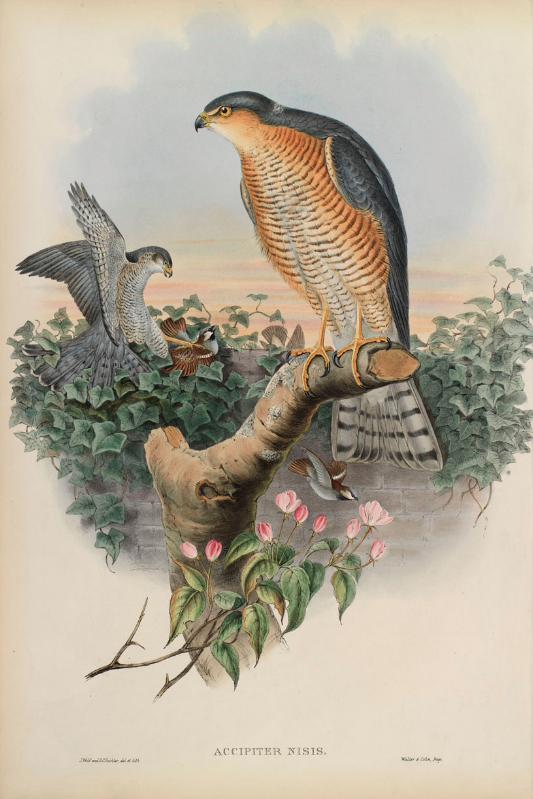
John Gould, writer, publisher and ornithologist, produced a monumental series of illustrated bird books covering Europe, Australia, Asia and New Guinea and his last fully completed work was "The Birds of Great Britain", published between 1862 and 1873 and generally considered to be his greatest achievement.
He enjoyed Royal Patronage and by the age of 23 was appointed Curator and Preserver of the collection of the Zoological Society where he developed the idea of attracting subscription from notable persons to finance limited edition folios of hand-coloured plates with descriptive text.
In the 1861 Prospectus, Gould confirmed "at the urgent request of scientific friends and subscribers" that it was to be issued in parts over 8 or 9 years, the completed set of 5 volumes to contain 367 plates, priced at £78.15s Od.
The project attracted 468 subscribers, led by Queen Victoria and 8 Dukes, 2 Marquises, 14 Earls, 5 Viscounts, 15 Lords and 11 Baronets. Universities, Libraries, and Scientific Institutions worldwide, together with any naturalist wealthy enough to commit themselves to the project readily made up the balance.
Although Henry Richter contributed the majority of illustrations, he was joined by Joseph Wolf, who was mainly concerned with the birds of prey, game and waterfowl, and William Hart who earlier had worked on Gould's humming birds. It was from reference to their watercolours and 'copy plates' made from them, that the black and white lithographs produced were so laboriously hand- coloured and heightened with gum arabic to a competence that sometimes surpassed the original in its effect. Gould himself, with some understatement, in his November 1873 preface, reflects that "Every sky with its varied tints and every feather of each bird were coloured by hand: and when it is considered that every illustration in the present work has been so treated, it will most likely cause some astonishment to those who give the subject a thought."
Register Interest

The frames with "Japanned" decoration of flowers, birds, Chinamen, buildings and gold lattice work. The tops of carved and giltwood decoration of floral sprays, scrolls and gadrooning. Retaining their original gilding, decoration and bevel edged two-plate mirrors.
Of exceptional quality this pair of Chinoiserie framed mirrors are attributable to the firm of Lenygon & Morant. Lenygon & Morant were dealers and leading designers and cabinetmakers of the Edwardian period specializing in re-creating furniture and decorative arts in the early 18th century taste. Founded in 1904 by Francis H. Lenygon, and merged with upholstery firm Morant & Co. in 1909 they had premises at 31 Old Burlington Street, London.
Circa 1910.
Height: 64¼ inch (163cm)
Width: 28 inch (71cm)
Depth: 1½ inch (4cm)
POA

An original watercolor design scheme by Waring & Gillow for an interior entitled "Scheme for No 1 Drawing Room”, for its refurbishment in 1956. Stamped with a seal and dated on reverse.
Dated 1956
Height: 28 inch (71 cm)
Width: 35.5 inch (90 cm)
Depth: 1 inch (3 cm)
POA
Excellent condition. Recently mounted and framed with windows cut out to show title, description, date and signature.

This carved wood, gilt and painted wall mirror with broken scroll pediment with central basket of fruit and flowers atop and carved shell below. The panelled frame with egg and dart borders and applied rosettes in each corner. The paint revived.
Circa 1860
Height: 47 inch (119.5cm) Width: 29 inch (73.5cm)
£3,650

Better known as “The Magnificent Steeplechase”.
Drawn by H. Alken, engraved by J. Harris and published by Ben Brooks 1839.
As discussed Of particular note is that an early pull is indicated by the shadow of the 5 bar gate not being broken in Plate III, subsequent impressions were amended.
Height: 24” (61cm) Width: 27” (68cm)
£1,750
Mirrors change a room faster than anything else, giving it another dimension, and period examples bring a depth and richness that modern example often miss. This collection includes overmantle and wall mirrors, specific pier glasses, convex and trumeaux, dressing table and cheval mirrors. The frames vary from wonderfully carved wood and burnished gold leaf, to painted and veneered, papier mache and carton pier to a variety of metal body and finishes. Look for strong frames, pleasing scale, and surfaces that add light without feeling harsh.
A fine and large early 19th century convex mirror with ebony slip and carved giltwood frame.
Retaining the frame makers label, S.B. Fuller, London.
Circa 1820
Diameter: 34” / 86.5cm Depth: 3” / 8cm
£9,500
Although we associate this type of mirror mostly with the early 19th century interiors they have been around for centuries; 12th century European glass blowers made spheres of glass, sections of which could be used as small mirrors.
Thomas Sheraton wrote in his Cabinet Dictionary of 1803: “The properties of such mirrors consist in their collecting the reflected rays into a point by which the perspective of the rooms in which they are suspended presents itself on the surface of the mirror and produces an agreeable effect.”
So from humble origins to modest “Banker’s Eye” mirrors, such as those seen in Dutch Old Master Paintings of the 16th century, to opulent and highly decorated convex mirrors of the Regency era. The one shown here is particularly elegant, of superb quality and relatively paired back form retaining it’s makers label.