


This striking wavy edged bowl with central punt can be a wall decoration as well as placed on a table.
One of the main characteristics of raku firing is a second firing at temperatures between 900 and 1,000 degrees C. After about an hour, the object is extracted from the oven when still hot with a pair of long iron tongs and placed in a container filled with different materials – such as wood shavings, saw dust and shredded paper. When in contact with these materials the ceramic triggers a combustion that causes chemical and physical changes in the fired object, which is then removed from the container and dunked in water. The combustion process eliminates the air particles within the ceramic, which results in a shrinking of the object and a change of color. Unglazed, if all the oxygen has been removed, the ceramic becomes black; otherwise it turns into varying shades of grey, depending on the oxygen left. In order to obtain the right color, therefore, the master potter must take into consideration several factors: the kind of fuel used, combustion times and desired final oxygen levels.
From a Private collection of contemporary ceramics.
Sardinian 1998
Height: 4 inch (10 cm)
Width: 18 inch (46 cm)
Depth: 18 inch (46 cm)
£550

"SOHO" by Piero Lissoni. This limited edition carpet was designed by Piero Lissoni and handmade in Sardinia. It depicts the island of Manhattan with a latitude line highlighting the Soho district in red. The Sardinian weavers of the Zeddinai Company used Sardinian fleece wool and the traditional technique called 'annodato'.
Sardinian, circa 1995
Dimensions: 3m x 2m
POA

Patch Chiaro - by Patricia Urquiola. This carpet was designed by Patricia Urquiola with traditional Sardinian influences in mind.The carpet was handmade in a small workshop in the middle of Sardinia which has been managed by the same lady for more than 60 years. The technique is ‘pibiones’, literally translated as ‘grapes' or ‘hoops’. Only Sardinian wool is used and the final colour fixing, using vinegar, was chosen by Patricia Urquiola.
Sardinian, circa 1995
Dimensions:2m x 3m
£6,500

A unique shallow bowl with pointed punt and uneven edge, the blue grey glaze over black ceramic exemplifying the Raku technique.
One of the main characteristics of raku firing is a second firing at temperatures between 900 and 1,000 degrees C. After about an hour, the object is extracted from the oven when still hot with a pair of long iron tongs and placed in a container filled with different materials – such as wood shavings, saw dust and shredded paper. When in contact with these materials the ceramic triggers a combustion that causes chemical and physical changes in the fired object, which is then removed from the container and dunked in water. The combustion process eliminates the air particles within the ceramic, which results in a shrinking of the object and a change of color. Unglazed, if all the oxygen has been removed, the ceramic becomes black; otherwise it turns into varying shades of grey, depending on the oxygen left. In order to obtain the right color, therefore, the master potter must take into consideration several factors: the kind of fuel used, combustion times and desired final oxygen levels.
From a Private collection of contemporary ceramics.
Sardinian, 1998
Height: 3.5 inch (9 cm)
Width: 18 inch (46 cm)
Depth: 18 inch (46 cm)
£900
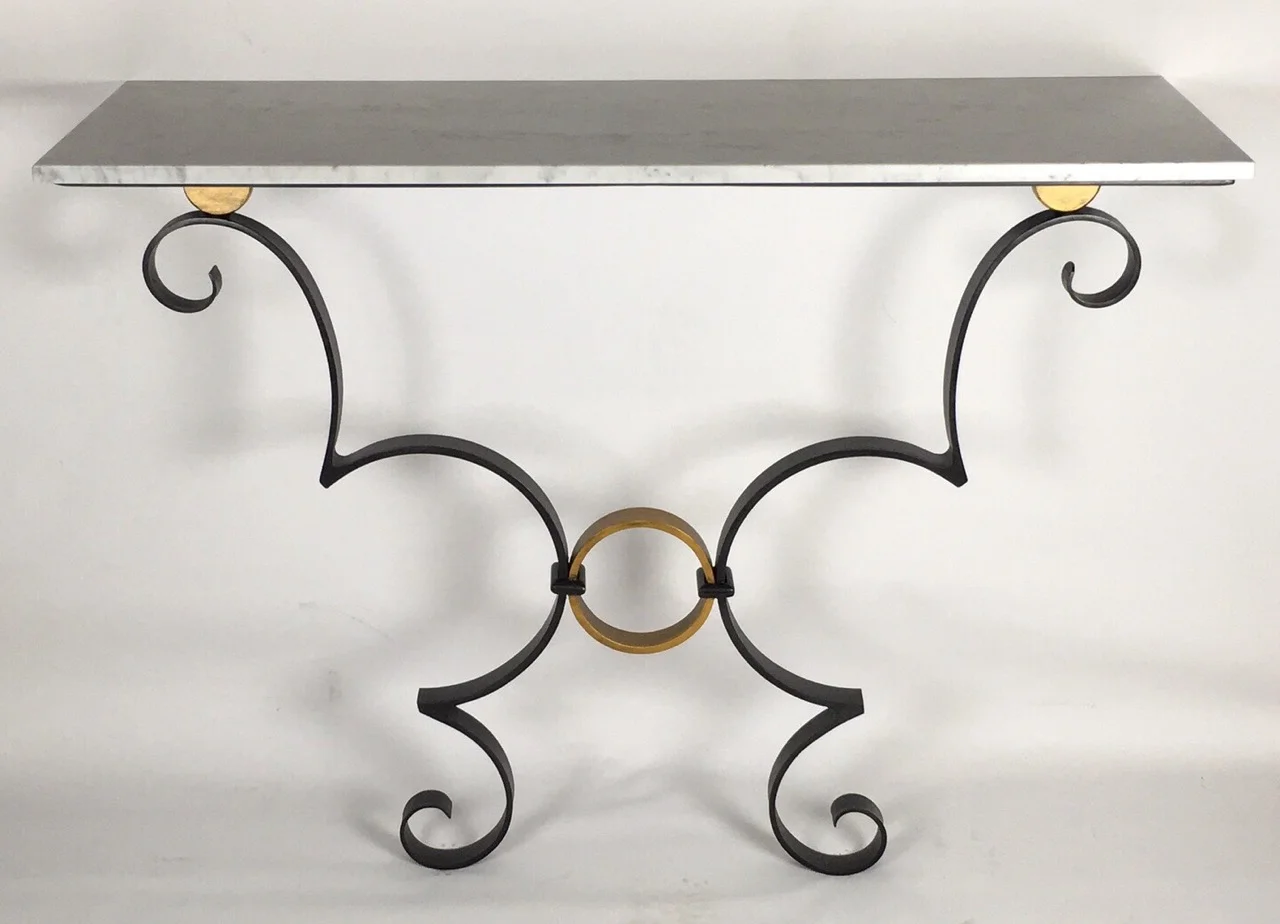
The base is hand forged steel, finished and treated individually by hand and shown with Carrara and Nero marble tops. Colours shown: Black and Gold.
These tables are made to order so can be made to size requirements and matching side and coffee tables can also be made.
A variety of marbles, granite, stone or glass tops can be supplied.
Height: 38 inch (96.5 cm)
Width: 48 inch (122 cm)
Depth: 216 inch (42 cm)
£4,500 plus VAT
A fine and striking model of a horse's head, hand forged and uniquely fashioned in textured bar steel by Charles Elliott for John Bly. Equally suitable for internal or external decoration. Charles was inspired by his wife's love and understanding of horses, and so created the horse’s expression to indicate a state of ‘fight or flight’, showing elements of fear but at the same time speed and courage.
A matching pair of smaller wall lights are also available.
Circa 2016
Height: 30 inch (76.20 cm)
Width: 23 inch (58.42 cm)
Depth: 21 inch (53.34 cm)
£6,500 plus VAT
Register Interest
<BACK TO CONTEMPORARY